Protecting Human Labor in the Digital Age
By Christian Salas, Workforce Development Policy Research Fellow at Gen-Z Emerging Technology Action (ZETA)
Artificial intelligence is transforming the nature of work at a pace that outruns policy decisions regarding equitable distribution of its benefits. While AI has the potential to enhance productivity and augment human capabilities, its deployment primarily for labor cost reduction poses significant risks. Workers may lose not only employment, but also access to entry-level positions, opportunities to develop professional judgment, and pathways for career advancement.
The central issue is no longer whether AI will transform work, as this transformation is already underway. The pertinent question is whether workers, particularly those from Gen Z, will receive paid learning opportunities, substantive protections, and viable pathways into the new roles created by AI as they enter the workforce over the coming decade during this transformation.
A Thinning Onramp for New Workers
AI is frequently promoted for its potential to increase efficiency through faster decision-making, reduced costs, and the automation of repetitive tasks. The International Labour Organization’s latest assessment suggests that generative AI is more likely to transform tasks than eliminate whole occupations. Even so, transformation can still diminish a worker’s autonomy, job quality, or chance to advance if employers automate the work that once served as a career on-ramp (International Labour Organization [ILO], 2025).
Current labor market data do not substantiate claims that AI has already resulted in widespread job displacement. For example, Gallup found that only 1% of laid-off U.S. workers in early 2026 attributed their job loss primarily to AI (Gallup, 2026). Nevertheless, significant pressure exists: the information sector lost 11,000 jobs in February 2026, continuing an average monthly decline of 5,000 jobs over the previous year (U.S. Bureau of Labor Statistics [BLS], 2026). Although these losses cannot be attributed solely to AI, they underscore the importance of ensuring that workers have a voice in how technology reshapes workplaces.
Beyond AI Literacy
While AI literacy is valuable, it does not constitute a comprehensive workforce development strategy on its own.
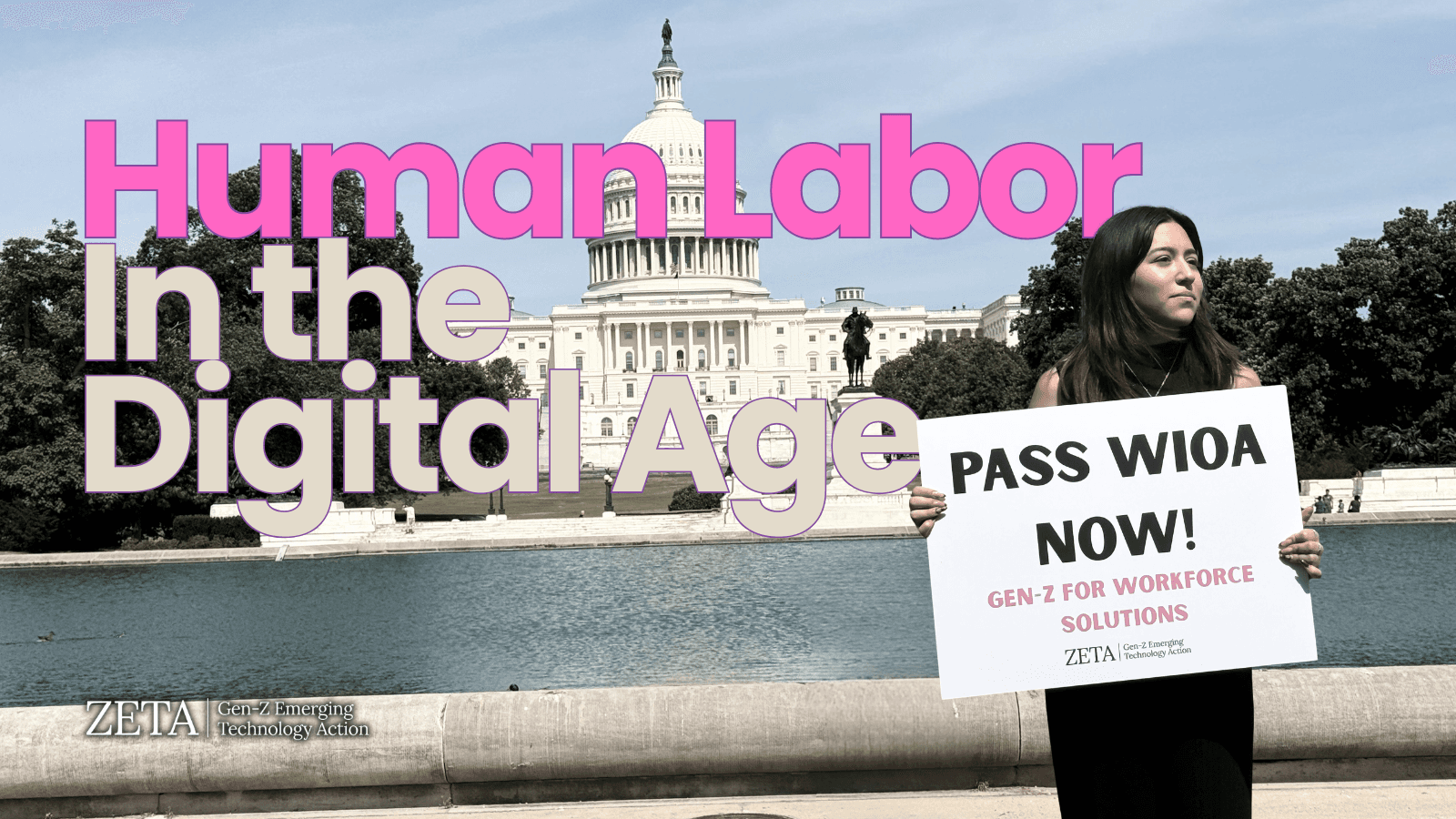
The Workforce Innovation and Opportunity Act, or WIOA, provides the public infrastructure needed to turn learning into opportunity. Through workforce boards, community colleges, youth programs, training providers, registered apprenticeships, and roughly 2,400 American Job Centers, WIOA connects people to career counseling, job search assistance, classroom training, and work-based learning (U.S. Department of Labor [DOL], n.d.-a, n.d.-b).
That local capacity matters. WIOA prioritizes employment and training services for people receiving public assistance, low-income workers, and people who are basic-skills deficient; its youth program serves eligible young people ages 14 to 24 who face barriers to education, training, and employment (DOL, n.d.-c, n.d.-d). For Gen Z and opportunity youth, that makes WIOA more than a funding stream. It is a pathway to paid experience, portable credentials, and a foothold in the labor market.
ZETA’s WIOA agenda expands upon this foundation. Modernization efforts should prioritize skill development pathways in sectors such as health care, cybersecurity, broadband and telecommunications, nuclear energy, and clean energy, all of which are experiencing rapid technological change and significant workforce demand. The objective should extend beyond the attainment of new certificates to include the creation of durable jobs, opportunities for wage progression, recognition of skills, and mobility across employers and state boundaries.
Public-Private Partnership: Joint Responsibilities
Recent AI-focused legislation, endorsed by companies such as Google, demonstrates how federal action can facilitate public-private partnerships in workforce development. Google has supported proposals aimed at assessing the economic impact of AI, expanding training opportunities, supporting workers, and promoting technology that empowers rather than displaces individuals (Google, 2026). These initiatives include the AI Workforce PREPARE Act, AI Workforce Training Act, and AI-WISE Act, among others (Google, 2026).
Their value is greatest when they strengthen WIOA. Federal legislation can improve labor-market data, direct resources toward emerging skills, and encourage employers to invest in training. WIOA can connect those investments to real people through local institutions that already understand regional employers, barriers to participation, and community needs.
Without that connection, AI training can become a patchwork of online courses available mainly to people with money, time, reliable broadband, and existing professional networks. Public funding should reward outcomes: completion, job placement, retention, wage growth, and advancement; not merely enrollments or certificates issued.
Employers also have a responsibility when they redesign work around AI. Verizon’s $20 million Reskilling and Career Transition Fund provides eligible departing U.S.-based employees with free digital training, access to more than 80 professional-certificate programs through edX, career coaching, résumé review, job-search assistance, and networking support (Verizon, 2026). The fund illustrates an important principle: companies that use technology to restructure work should help workers transition into what comes next.
A Verified Starting Point for AI Capacity
The following programs are strong examples of starting points for individuals and institutions building AI capacity. They serve different needs, from entry-level AI literacy to executive implementation and employer-supported career transition. Costs, eligibility, and schedules should always be confirmed directly with the provider.
Google AI Essentials | Foundational AI literacy and prompting | Self-paced; $49/month in the U.S. and Canada after a seven-day trial | An accessible first step, but not a substitute for occupational training or work experience |
OpenAI Academy | Practical AI learning for community, business, government, and workforce audiences | Free courses, events, and skill labs | Low-barrier exposure and confidence-building; completion alone does not guarantee employment |
MIT Professional Education: Applied Agentic AI | Organizational AI strategy, governance, and workflow redesign | Eight-week online program; published fee of $3,250 | Useful for leaders responsible for deployment; employer sponsorship is important for equity |
Harvard and HBS Online AI programs | Business, leadership, policy, and technical AI learning | Mostly online; program-specific pricing | Strong structured learning options, though cost and prerequisites vary |
Verizon Reskilling and Career Transition Fund | Career transition for eligible Verizon alumni | Free digital learning, certificates, coaching, and placement support | A useful employer-financed model, though limited to eligible participants |
Meta America’s Workforce Academy | Skilled trades and infrastructure workforce training | Free for qualified participants; supports tuition and, in some cases, participation costs | Demonstrates a job-linked pathway model, particularly for broadband and infrastructure careers |
Note. Program descriptions reflect publicly available provider information and should be verified before enrollment (Google, 2026; Harvard University, 2026a, 2026b; Meta, 2026; MIT Professional Education, 2026; OpenAI, 2026; Verizon, 2026).
The Standard Should Be Opportunity
Training alone is not protection. An employer cannot credibly claim to prepare workers for AI while eliminating entry-level roles, withholding paid learning time, or allowing opaque systems to determine hiring, scheduling, evaluation, discipline, or termination.
A people-centered AI workforce agenda should require four things:
Paid learning time when AI meaningfully changes a worker’s role.
Worker input before systems are deployed in real workplace workflows.
Clear pathways from courses to credentials, supervised practice, apprenticeships, internal mobility, and higher wages.
Meaningful human review, transparency, privacy protection, and appeal rights when AI affects employment decisions.
AI can become a tool for more productive and creative work. But that outcome is not automatic. WIOA provides the local infrastructure; federal policy can direct new resources and accountability; and employers can demonstrate that technological change does not have to mean abandonment.
The measure of success should not be the number of people who complete an AI course. It should be whether workers gain the security, skills, voice, and dignity to shape the future of work rather than simply endure it.
References
Gallup. (2026, June 17). U.S. workers continue to report downsizing. https://www.gallup.com/workplace/711287/workers-continue-report-downsizing.aspx
Google. (2026, May 9). Google supports bipartisan bills to prepare U.S. workforce for AI. https://publicpolicy.google/article/bipartisan-bills-ai-workforce/
Harvard University. (2026a). Artificial intelligence courses. https://pll.harvard.edu/subject/artificial-intelligence
Harvard University. (2026b). AI courses for business and organizational leadership. Harvard Professional & Executive Development. https://professional.dce.harvard.edu/ai-courses/
International Labour Organization. (2025, May 21). Generative AI and jobs: A 2025 update. https://www.ilo.org/publications/generative-ai-and-jobs-2025-update
Meta. (2026). America’s Workforce Academy. https://www.meta.com/actions/americas-workforce-academy/
MIT Professional Education. (2026). Applied agentic AI for organizational transformation. https://professionalprograms.mit.edu/online-program-agentic-ai-organizational-transformation/
OpenAI. (2026). OpenAI Academy. https://academy.openai.com/
U.S. Bureau of Labor Statistics. (2026, March 11). Total nonfarm payroll employment down by 92,000 in February 2026. The Economics Daily. https://www.bls.gov/opub/ted/2026/total-nonfarm-payroll-employment-down-by-92000-in-february-2026.htm
U.S. Department of Labor, Employment and Training Administration. (n.d.-a). American Job Centers. https://www.dol.gov/general/topic/training/onestop
U.S. Department of Labor, Employment and Training Administration. (n.d.-b). WIOA workforce programs. https://www.dol.gov/agencies/eta/wioa/programs
U.S. Department of Labor, Employment and Training Administration. (n.d.-c). WIOA adult and dislocated worker program. https://www.dol.gov/agencies/eta/workforce-investment/adult
U.S. Department of Labor, Employment and Training Administration. (n.d.-d). WIOA youth formula program. https://www.dol.gov/agencies/eta/youth/wioa-formula
Verizon. (2026). Reskilling and career transition fund. https://www.verizon.com/about/responsibility/human-prosperity/reskilling-program