A New Energy-Conservation Synthesis: Lessons from the MIT Classroom
By José Ignacio Gaona Cardona, President and CEO, ZETA
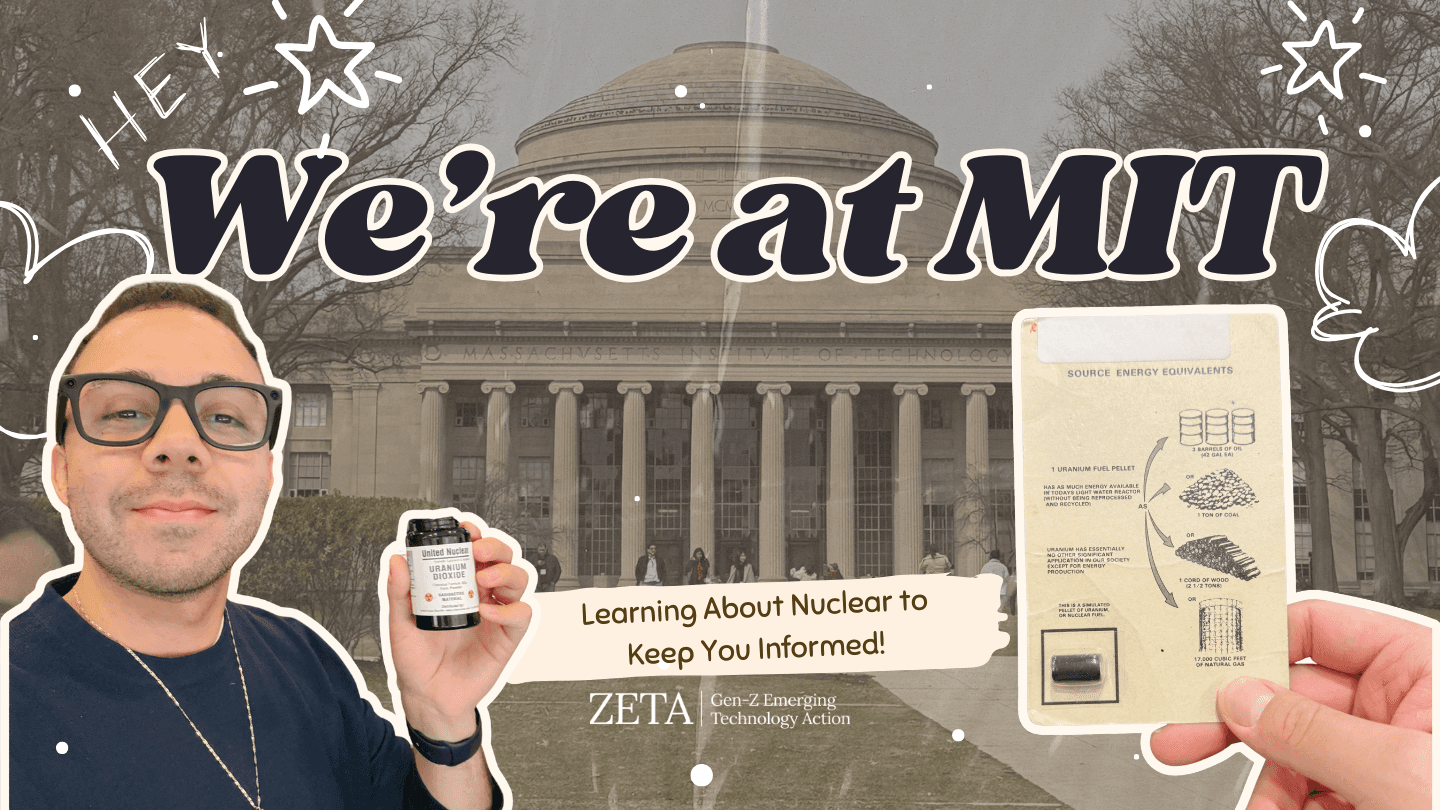
This March, I spent a week in a classroom at MIT, listening to lectures on reactor physics, waste, safety, and public opinion. Around me sat legislators, tribal council staff, environmental advocates, industry experts, and delegates from all over the world. I was there as the CEO of Gen‑Z Emerging Technology Action(ZETA), and as someone who has previously fought to keep uranium mines away from the Grand Canyon watershed. It is an unlikely arc: from organizing to block uranium mining to building out nuclear energy support as a core pillar of ZETA’s campaign work. Spending four days in Cambridge further making the case to myself that nuclear energy not only belongs in our climate future, but deserves a far more honest defense was an affirming experience to say the least.
From protecting landscapes to confronting demand
Nuclear energy stopped being background noise for me when I joined the National Wildlife Federation as a national policy manager, working with leaders across the Southwest on land and water conservation. Much of that work revolved around mining, especially uranium, and the rising energy appetite of a world increasingly powered by data centers and artificial intelligence. It became impossible to talk about conservation without talking about what we were conserving against: not just sprawl and industrial development, but a grid straining to satisfy ever‑growing demand.
The most formative campaign of that period for me was the push that ultimately expanded the Grand Canyon national monument area. The goal was simple and profound: protect a sacred landscape and fragile watershed from development and uranium mining that threatened downstream communities and a tourism economy worth billions. I am still proud of the part I played in that effort. At the time, uranium felt like pure risk: a material that endangered water, public health, and trust.
What shifted for me over the years was not my commitment to conservation, but my understanding of what conservation now requires. We are trying to protect those same lands and waters in the context of a rapidly heating planet and a digital economy that does not sleep. That reality forces a blunt question: if we reject high‑density, zero‑carbon power like nuclear on principle, what landscapes and communities are we implicitly volunteering in its place?
From fear to informed advocacy
Like many who grew up watching coverage of nuclear accidents on television, my early view of nuclear was shaped more by fear than by fact. Even as a conservation professional, I held on to a quiet wish: that nuclear might someday be led by people who took mining, community consent, and long‑term stewardship as seriously as they took megawatts.
By the time I founded ZETA, that wish had turned into an obligation. Gen Z is the first generation to consistently prioritize climate solutions across political lines, but it is also a generation still making up its mind about nuclear. Most young people I meet are climate‑serious and intensely skeptical of narrative spins by big business. They want to know how we will keep the lights on, power AI, and stop burning the planet, and they have little patience for hand‑waving.
So I went to MIT not as a neutral observer, but as someone who suspected nuclear needed a fairer hearing… and who knew that, if I was going to help make that case to my generation, I had to test it against the hardest questions.
Inside the MIT course
The course I attended, “Nuclear Energy: Key Facts and Issues,” was a four‑day immersion hosted by MIT and Clean Air Task Force. The agenda moved briskly: nuclear and climate change, plant basics, radiation health science, safety, public opinion, the fuel cycle, nonproliferation, advanced reactors, fusion, and the uses of nuclear energy beyond electricity. It was the opposite of industry boosterism. We spent as much time on cost overruns, siting battles, accident histories, and waste management as we did on climate benefits.
My conservation background followed me into every session. When we discussed uranium mining and the fuel cycle, I saw not just diagrams, but specific landscapes and communities in the Southwest. There is still a meaningful gap between what industry says about modern mining practices and what communities near those sites feel and experience. Closing that gap will require leaders willing to sit at uncomfortable tables and design supply chains that are as disciplined and transparent as the best‑run nuclear plants themselves.
The most clarifying moment came during a visit to the Seabrook Nuclear Power Plant. In the control room, surrounded by layers of instrumentation and procedure, the story of nuclear I had grown up with felt almost unrecognizable. The industry has been forced, through painful history and scrutiny, to become obsessive about safety. The design philosophy is redundancy upon redundancy, constant training, and a culture that treats complacency as an existential threat. That does not erase past accidents, nor does it eliminate risk. But seeing that system up close made it harder to sustain the caricature of nuclear as a reckless experiment perpetually on the brink of catastrophe.
Outside, the physical footprint of the plant was strikingly small compared with the amount of electricity it produces. For someone who has spent years fighting to keep industrial projects away from irreplaceable landscapes, that ratio matters. High‑density, low‑carbon power is not a theoretical talking point; it is a way to meet enormous energy demand while disturbing less land.
A global, uneasy consensus
Perhaps the most hopeful part of the week was the people in the room. Staff from state and federal agencies, environmental NGOs, tribal and First Nations organizations, climate reporters, consultants, and international delegates all asked hard questions. There was no uniform line. Some worried most about cost and timelines, others about waste, others about proliferation. Almost everyone worried about public trust.
What united the group was a kind of uneasy consensus. In a world that needs deep decarbonization, nuclear is no longer a novelty or a luxury. It is a piece of the climate puzzle that we neglect at our peril. That does not mean we must accept any project, under any conditions, in any place. It does mean that a blanket rejection of nuclear has become, in practical terms, a decision to lean harder on fossil fuels or to push the impacts of other energy choices onto different communities.
I also heard something else: a surprising openness to Gen Z voices. People were eager to understand how a generation that is both climate‑urgent and wary of institutions will react to a nuclear “renaissance.” Some assumed that positive polling meant the narrative had shifted for good. I am less certain. Young people who never lived through Chernobyl or vividly remember Fukushima are, in some ways, approaching nuclear with fresh eyes. Their support is real, but fragile. It will not survive a return to secrecy, spin, or arrogance.
What I tell a skeptical Gen Z activist
If you asked me today to explain nuclear to a skeptical Gen Z climate activist, I would start with three points.
First, nuclear is one of the most efficient and reliable clean energy sources we have. It can provide around‑the‑clock, zero‑carbon power in a way that complements wind, solar, and storage rather than competing with them. Without more firm clean power, integrating very high shares of variable renewables becomes significantly harder and more expensive.
Second, the safety story is not what most of us absorbed as children. Serious accidents have happened, with real human and environmental costs, and they should never be minimized. But those incidents also drove an extraordinary tightening of design, regulation, and culture. On a per‑unit‑of‑electricity basis, nuclear has caused far fewer deaths than fossil fuels, which quietly kill through air pollution and climate impacts every day.
Third, there are still open issues: mining practices, waste stewardship, proliferation risks. Supporting nuclear does not require pretending those are solved. It requires believing they are solvable—and demanding that we solve them with the same seriousness we bring to the design of reactors themselves.
Community consent and conservation values
For me, being pro‑nuclear is not a departure from conservation. It is an extension of it. If we are serious about protecting lands and waters in a rapidly warming world, we need energy systems that minimize both emissions and physical footprint. Nuclear can do that, but only if it is embedded in a different kind of relationship with communities.
That means community‑led processes for deciding whether and how projects move forward. It means incident warning systems and emergency planning that are built with local residents, not simply presented to them. It means treating tribal and frontline communities as partners and rights‑holders, not as sacrifice zones or afterthoughts. And it means acknowledging that trust, once broken by extractive industries of all kinds, is not rebuilt by press release.
I am still uneasy about proliferation. I want a world where the expansion of civilian nuclear power is matched by credible, verifiable steps toward nuclear weapons disarmament. That tension does not vanish because the climate crisis is urgent. It simply becomes another dimension we must hold with honesty.
ZETA’s place in the conversation
After MIT, I see ZETA’s role more clearly. We are not an industry lobby. We are not an anti‑nuclear protest movement. We are an education organization trying to give Gen Z the tools to think clearly about technologies that will shape their lives: artificial intelligence, quantum computing, digital infrastructure, and, yes, nuclear energy.
We plan to continue the work with institutions like MIT and organizations like Clean Air Task Force to bring more young leaders into these rooms, to strip away jargon, and to tell fuller stories—stories that include both the control room at Seabrook and the communities living near uranium mines, both the promise of decarbonization and the politics of siting. Our stance is unapologetically pro‑nuclear, but it is also pro‑community and pro‑accountability.
Responsible energy innovation, in that sense, is less a slogan than a discipline. It is the work of insisting that our clean energy systems be not only low‑carbon and reliable, but also just, transparent, and worthy of the trust we ask communities to place in them. That is the work I carried into that classroom at MIT. It is the work I carried back out with me, a little more informed, a little more hopeful, and a lot more certain that my generation belongs at the center of this debate, not on its sidelines.